Is Taboo suitable for children?
Classic Taboo is sold for ages 13 and up, and its rules ban gestures, noises and sound effects. Hasbro also makes a family edition, Taboo Kids vs Parents, for ages 8 and up. Its kids' cards print only 2 forbidden words each, and every turn runs on a one-minute timer.
That shows what changes for younger players: familiar words, fewer banned words and a little more time. Taboo Party has no printed taboo list at all. The only words a describer must avoid are the words on their own board, which is already gentler for a child who is still learning to explain things.
A child who is not ready to describe can still guess, and guessing is half the game. Put them on a team with a patient describer for the first round, then offer them the describer seat once they have seen how a turn works.
What does Taboo Party do for players under 13?
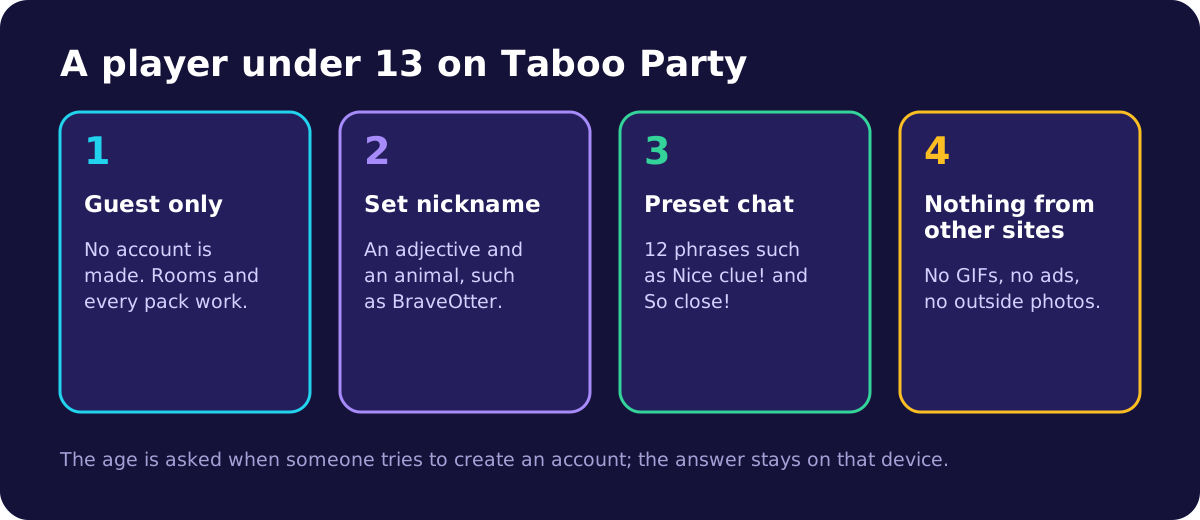
Taboo Party asks for a birth month and year when someone tries to create an account, on a sheet titled "When were you born?". If the answer is under 13, no account is made and the game shows "You can keep playing as a guest" instead. Rooms, invites and every word pack still work.
- The child does not type a name. They get a generated nickname, an adjective and an animal such as BraveOtter, with a button to shuffle it.
- Chat is limited to 12 preset phrases, such as "Nice clue!", "So close!" and "Good game!". The server refuses anything else, so a child cannot type free text to other players.
- No GIFs are sent or shown. Where another player posted one, the child sees a plain [GIF] label.
- That device loads no ads of any kind, neither Google ads nor the site's own banners, and no profile pictures from Google or Discord accounts. Those companies do not receive the child's IP address from the game.
- The game records no analytics events for the child, and keeps only what it needs to run the game and keep it secure.
The answer stays on that device, and a later answer cannot loosen it. If a birth date was entered by mistake, the guest note links to the contact page, and a parent can ask by email for it to be corrected.
These protections switch on once the age has been given on a device. A parent who wants them on a child's tablet can press sign in on that tablet and enter the child's real birth month and year. Guests who never give an age play like any other guest, and their typed chat passes a filter that masks rude words, links, email addresses and phone numbers.
From 13 May 2027, India's Digital Personal Data Protection rules for children apply, and under them a child is anyone under 18. From that date players in India will be asked their age before they play. Accounts for players in India under 18 will need verifiable consent from a parent or guardian.
The full details, including what is kept and for how long, are in the Taboo Party privacy policy, which has a section on children under 13.
Which word pack suits kids?
Start with Taboo - Easy, which deals only easy words worth 4 to 12 points from a list of 1,493 words. The Standard pack mixes in medium and hard words, and hard words are where most young players get stuck.
The built-in packs are written for a general audience, not for young children. The easy tier also holds everyday adult words such as Alcohol and Arrest, so sit with younger players for their first games, or bring a list of your own.
A custom word pack gives you full control of every word on the board. It needs at least 100 words, with at least 10 in each tier you use, and its owner has to be in the room. Animals, foods, school words and family in-jokes make a pack children love to describe.
Theme ideas, tier balancing and the pack format are all in the guide to making a custom Taboo word pack.
For a family that speaks Hindi at home, Taboo - Hindi (Easy) has 698 words and scores them like English easy words. Grandparents who describe more comfortably in Hindi can then play on equal terms.
If you warm up with paper cards, write them the way the family edition does, with just two banned words. Here are three words from the game's easy tier, with clues a young describer could give.
- It is black and white and it waddles.
- It lives where it is very cold and it swims really fast.
- You open it over your head when the weather is bad.
- It folds up small and has a curly handle.
- You sometimes see it when the sun comes out after a storm.
- It is a big arch of red, orange, yellow, green, blue and purple.
How long should turns and games be for kids?
Use 90-second turns, the longest the lobby offers, and fewer rounds than the default. Turn time can be 30, 60 or 90 seconds, and a game lasts 3, 6, 9 or 12 rounds.
3 rounds with 2 teams is 6 turns, which at 90 seconds is 9 minutes on the clock. With the turn summaries in between, the whole game takes about 13 minutes.
The clock only starts when the describer presses Start turn. A child can take a breath, read the board and ask an adult what a word means before the timer runs.
Start short. Play again sends everyone back to the lobby of the same room, so a second game is one button away if the room wants more.
How do you make teams fair across ages?
Mix ages inside each team rather than playing kids against adults. Players can pick a team card themselves, the host can press Randomize to deal players evenly, or press Draft so captains pick teams after a coin flip decides who picks first.
The describer role passes to the next player on a team after every turn, so team size decides how often each person describes. In a 6-round game each team plays 6 turns. On a team of three everyone describes twice, and on a team of two each player describes three times.
- Put a shy child on a bigger team, so they describe less often and guess more.
- Put a keen child on a smaller team, so they get more turns at the front.
- In a casual game, the host or a team captain can open a player's menu on the team list and choose Make describer, to give a turn to someone who missed one.
- Skip my turn on the turn card hands the turn to the next teammate with no points lost. It suits a child who would rather guess this time, on any team with more than one player.
- For three players, pick one team. It is a co-operative game for two or more players, where everyone works together for a high score.
House rules that help younger players
Taboo Party enforces the timer, the board and the points. Everything else is a house rule, so agree a few gentle ones before the first turn and post them in the room chat.
- Allow gestures and sound effects for younger children. The classic rules ban them, but a child who flaps their arms and squawks is still describing.
- Allow "sounds like" and rhymes for beginners, and take them away once a child is confident.
- Hints cost coins, and only a signed-in guesser on the playing team can buy one, so a child under 13 cannot. An adult on the child's team can buy the first letter, 3 coins on an easy word, and read it out.
- Taboo reporting and Taboo voting start switched off in casual rooms. Leave them off, so a slip is a laugh rather than a lost score.
- Keep the Describer voice check off. It flags any board word the describer says aloud and listens for English only, which is strict for a child who is still learning.
Older children often want the real rules. A middle ground works well: switch reporting on, and agree that the family reports adults' slips and waves through the younger players' ones.
Running it in a family or a classroom
Every player needs their own device, because the describer reads from their own screen and guessers type on theirs. In one living room a phone each is enough. On a call with grandparents, the call carries the talking and each person plays in their own browser tab.
An adult should host. Hosting normally needs a free account, which comes with a monthly allowance of hosted games, and a child under 13 cannot have one. Children join with the six-character room code and need no account.
Once a game starts, it can appear in a public list of games that anyone may watch as a spectator, though spectators cannot chat. To keep a family game private, press Disable spectating in the host controls, and press Lock room in the lobby so nobody else can join.
For lesson plans, word lists from a unit and assessment ideas, use the guide to Taboo for classrooms and English learners. Everything here about players under 13 applies in a classroom too.
For a bigger family gathering, the Taboo game night hosting checklist works out game length for every round and team setting.